
Nigeria’s population is growing rapidly, and with it, the demand for food continues to rise. According to national projections, food consumption is increasing faster than domestic production. This imbalance has resulted in rising food prices, increased imports, and pressure on foreign exchange.
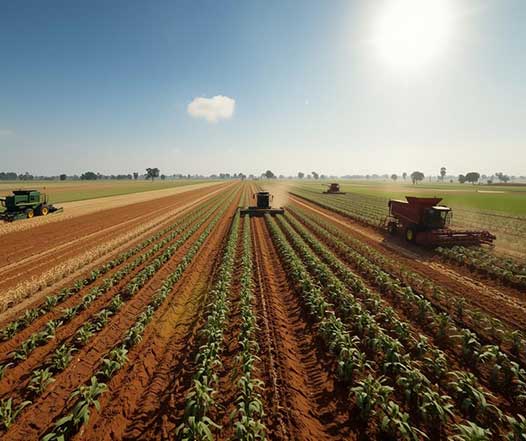
Smallholder farming has played a vital role in Nigeria’s agricultural history. However, today’s realities demand more structured, scalable, and industrial approaches to farming. Large-scale mechanized agriculture is no longer optional — it is necessary.
Mechanized farming increases efficiency, reduces post-harvest losses, improves yield per hectare, and ensures consistency in supply. It allows farms to operate at a scale that can meet both consumer and industrial demand.
At Osychris Farms, we have embraced this model by developing structured plantations for cassava, rice, palm trees, and coconut trees across extensive hectares of secured farmland. Beyond cultivation, we integrate processing plants that convert raw harvests into higher-value products such as cassava starch, palm oil, palm kernel oil, coconut oil, coconut milk, and processed rice.
This integration ensures:
- Steady production cycles
- Reduced waste
- Better quality control
- Stronger supply chain reliability
- Increased profitability
Food security is directly linked to national stability. When a country can produce enough food locally, it reduces dependence on imports, strengthens its currency, creates jobs, and stabilizes prices.
Large-scale agro-business is not just about farming — it is about economic transformation.
Osychris Farms is committed to playing a strategic role in building Nigeria’s food security through mechanized, structured, and value-driven agriculture.

